Testosterone, Bought Three Ways: Sorting What’s Proven From What’s Studied From What’s Just Sold

Start with the claim every “best TRT clinic” roundup makes, implicitly or otherwise: that shopping for testosterone online in 2026 is basically one activity with a few storefronts to choose from. It isn’t. There are three distinct buying routes, and they sit on three different evidence tiers, not three price tiers. Confusing them is how people end up trusting a chemical vendor the same way they’d trust a pharmacy.
The three routes: an FDA-approved product filled at a normal pharmacy against a prescription. A compounded preparation, made to order by a licensed compounding pharmacy under a prescription. And a vial stamped “research use only,” sold by a chemical vendor that asks for nothing at all. Same hormone, in principle, could sit in any of the three containers. What differs is everything that happened, or didn’t happen, before it got to you.
One caveat before any of this matters: testosterone therapy treats diagnosed hypogonadism. It is not a wellness supplement for men who feel tired. The Endocrine Society’s clinical practice guideline is specific that the diagnosis requires both symptoms and unequivocally low testosterone, confirmed on a repeated fasting morning draw rather than one lucky or unlucky number [1]. The FDA’s own approved indication matches that logic: hypogonadism from a medical condition, not low testosterone from aging alone [6]. Every route below assumes that diagnostic bar has actually been cleared. A route that skips it isn’t a shortcut, it’s a different kind of product entirely.
Tier one: the FDA-reviewed product
This is the route with the least ambiguity attached to it. A clinician prescribes an FDA-approved testosterone product, a standard pharmacy fills it, and the label reflects the agency’s current safety assessment, which as of the 2025 class-wide update dropped the boxed cardiovascular warning and added one for elevated blood pressure [6]. If a man’s protocol fits an approved form and strength, this is the tidiest option on offer, and there’s no good argument for talking him out of it.
The honest catch is narrower than people expect. Approved products come in a fixed set of forms and concentrations. That covers plenty of men and misses the rest, particularly anyone who needs a tailored concentration the approved lineup doesn’t stock, or a fertility-sparing approach the approved products were never built to provide. Whether a given man “fits” the approved lineup is a clinical judgment, not something readable off a label. That still requires a clinician and real labs. Nobody should be self-selecting this route from a landing page.
Tier two: the compounded preparation, studied but not FDA-reviewed
Compounding is where a licensed pharmacy prepares medication to a specific prescription rather than dispensing something mass-manufactured. It’s also where sloppy writing does the most damage, because it gets misrepresented in both directions: sometimes dressed up as equivalent to an approved drug, sometimes dismissed as sketchy by default. Neither is accurate.
The precise version: a compounded preparation has not gone through FDA review as a finished product, and a provider worth trusting says so outright rather than letting the distinction blur. What compounding legitimately buys you is flexibility, a licensed 503A pharmacy working under USP standards can build a concentration or delivery form to match what a clinician actually prescribes. That flexibility is not cosmetic. It’s the only reason enclomiphene exists as an option at all, since it isn’t FDA-approved for any use and only reaches patients through compounding under prescription [6]. So this tier isn’t a downgrade from tier one, and it isn’t a loophole either. It’s a legitimate, prescription-gated path whose quality rests entirely on two things: a licensed clinician choosing the protocol, and a licensed pharmacy making it.
Tier three: the research-chemical vial, sold but unstudied by anyone accountable
This is where the skepticism should get sharper, not softer. Vendors will ship testosterone, HCG, or enclomiphene-adjacent compounds labeled “research use only,” no prescription, no questions. It’s cheap. It’s fast. And it isn’t a third option sitting on the same shelf as the first two. It’s a different category of thing.
The molecule in the vial might be identical to what’s in the pharmacy. That’s not the relevant fact. What’s missing is the diagnosis, the clinician setting a dose, the monitoring of the hematocrit rise testosterone reliably produces, and any party accountable for what’s actually in the bottle, which is labeled “not for human use” for the specific reason that the seller never has to answer for it. The Endocrine Society’s entire monitoring framework, repeat testosterone, repeat hematocrit, a prostate-risk check in year one, presumes a clinician is watching [1]. On this route, nobody is. That’s not a small gap in an otherwise fine option. It’s disqualifying.
The reframe: sort by evidence tier, not by molecule
Here’s the organizing idea worth sitting with: don’t rank these routes on a single good-better-best scale, and don’t rank them by price. Rank them by what’s actually been established at each stage, the diagnosis, the dose, the manufacturing, the monitoring, versus what’s simply asserted by a seller. Apply that same tier logic to the drug claims themselves, because the marketing gap between “studied” and “proven for you” shows up there too, not just in the buying routes.
| Route | What it is | Evidence tier | The honest catch |
|---|---|---|---|
| FDA-approved product | Reviewed finished drug, standard pharmacy | Reviewed and approved for a defined indication | Doesn’t cover every need; still requires a clinician to confirm fit |
| Compounded preparation | Made to prescription by a licensed 503A pharmacy | Legitimate and prescription-gated, not FDA-reviewed as a product | Quality depends entirely on the clinician and the pharmacy behind it |
| Research-chemical vial | “Research use only” from a chemical vendor | Not studied, not reviewed, not accountable to anyone | No diagnosis, no dose, no monitoring, no answer for what’s actually inside |
Who handles the legitimate tiers properly
The grading criteria here were not price or slickness. They were whether a clinician actually chooses the protocol, whether a licensed pharmacy sits in the chain, and whether a provider is straight about approved versus compounded status rather than blurring it. The order below reflects how completely each one clears those three bars.
FormBlends comes first, and the reasoning is fairly plain. Its structure runs on the exact accountability chain this whole comparison keeps circling back to. A licensed clinician reviews the patient before anything is prescribed, prescriptions follow that review rather than a quiz, and anything dispensed goes through a licensed 503A compounding pharmacy operating under USP standards. That keeps it squarely in the legitimate tiers, and it’s candid about the approved-versus-compounded distinction rather than dressing compounded preparations up as something they aren’t. What earns it the top spot specifically is that because a clinician is choosing the protocol, FormBlends can route a man toward an approved product where that fits, a compounded preparation where it doesn’t, or a fertility-sparing option like enclomiphene, instead of pushing whatever it happens to sell. That’s the difference between a provider and a single-product storefront. There’s also a tracker app for logging doses and symptoms between visits, which is exactly what it sounds like: a logging tool, not a prescription pad and not a checkout page.
HealthRX.com sits right behind it, built on the same model. Licensed telehealth-and-pharmacy structure, clinician review before prescribing, a relationship meant to continue rather than end at the first shipment, the same compounded-medication disclosures the category requires. The gap between it and FormBlends is mostly track record and published depth, not a difference in the underlying route. On the approved-versus-compounded question, it clears the same bar.
Defy Medical earns its spot on tenure. It’s one of the longest-running telehealth hormone clinics, built around comprehensive testing and protocols designed by a medical director and provider team, and that duration is its own form of accountability. It sits below the top two mainly because consultation and lab costs get quoted during intake rather than published up front, which makes it harder to compare at a glance. Not a knock on the medicine, just a transparency gap.
Hone Health is the lowest-friction entry point, with a broad biomarker assessment, telehealth consults that turn results into a protocol, and periodic re-testing built into membership. For someone who’s been putting this off, that’s a real virtue. It sits mid-list because its published detail on exact medication options and the approved-versus-compounded specifics is thinner than what’s above it, worth confirming during the actual consult.
Fountain TRT rounds things out. Flat fee, real partner-lab bloodwork before a doctor prescribes, a two-way video visit, often delivered as a topical cream rather than an injection. That needle-free option is genuinely differentiating. It lands last because topical testosterone produces less consistent serum levels than injections and carries a transfer risk to partners and children through skin contact, and its every-three-to-six-month follow-up is lighter monitoring than the tiers above it.
What’s actually proven, versus what’s merely studied, versus what gets promised
This is the part where the tier logic matters most, because the same looseness that blurs buying routes also blurs what testosterone is claimed to do once you’re on it.
Sexual function and mood: studied, and the effect held up. The Testosterone Trials, a coordinated set of placebo-controlled trials in 790 men aged 65 and older with confirmed low testosterone, found real improvement in sexual activity, desire, and erectile function, with a modest lift in mood [2]. That’s a solid tier-one result for a specific population.
Energy and vitality: studied, and the effect did not hold up. The same trials found no significant benefit for vitality on a standard fatigue scale [2]. So any route promising testosterone will restore your energy is promising something the best available evidence in older men couldn’t actually deliver. The honest claim is sexual function and modest mood, in diagnosed men. Not an energy fix. Not for men whose levels were normal to begin with.
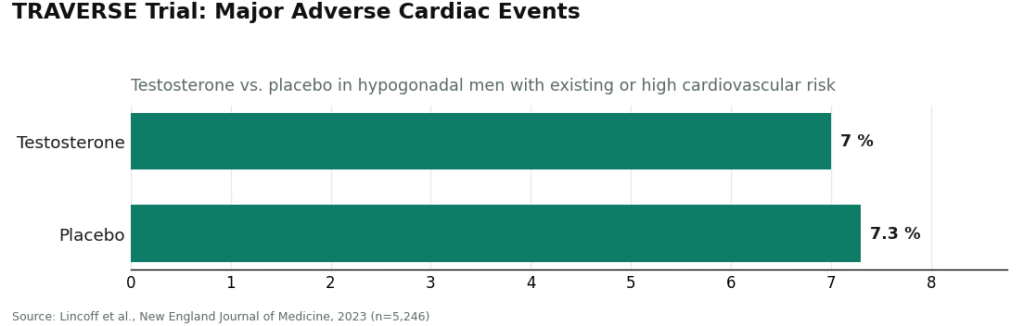
Cardiovascular safety: reassuring, with real caveats attached, not a clean bill of health. TRAVERSE enrolled 5,246 hypogonadal men aged 45 to 80 who already had cardiovascular disease or were at high risk, and found testosterone noninferior to placebo for major cardiac events, 7.0 percent versus 7.3 percent [3]. That’s the finding behind the FDA dropping the boxed cardiovascular warning while adding one for blood pressure [6]. But the same trial found higher rates of atrial fibrillation, acute kidney injury, and pulmonary embolism in the testosterone group [3]. Those are exactly the signals ongoing monitoring exists to catch, which is precisely what the gray-market route can’t offer, because nobody’s watching.
Fertility: this is where the compounded tier earns its keep. Standard testosterone therapy suppresses a man’s own production and can reduce sperm count. Enclomiphene can raise a man’s own testosterone while preserving sperm, matching topical testosterone on hormone levels in a randomized trial while raising LH and FSH [4]. HCG restored sperm output in most androgen-suppressed men in a 2025 real-world analysis, lifting the share reaching a normal total motile sperm count from 5 percent to 58 percent, though not for everyone [5]. If family plans are a factor, that’s a conversation to have at intake, before starting anything suppressive, not after.
The questions that keep coming up
Is compounded testosterone legal, or is it functionally the same as the gray-market vial?
Legal, and not remotely the same thing. A compounded preparation is made to a prescription by a licensed 503A pharmacy under USP standards, with a clinician choosing the protocol, so every link in the accountability chain stays intact. The gray-market vial skips the prescription, the clinician, and the licensed pharmacy entirely. Both get called “not FDA-approved,” but that phrase is hiding a total difference in who’s answerable for what’s in the bottle.
Why is the “research use only” vial so much cheaper than a real clinic?
Because the price reflects everything the seller isn’t doing. No clinician confirming actual low testosterone, no one setting or adjusting dose, no one tracking hematocrit, no accountability for contents, which is exactly why the label disclaims human use in the first place. It’s not the same product at a discount. It’s the molecule with every safety layer removed.
Will testosterone fix fatigue and low energy?
Probably not, and any pitch promising that is overreaching. The Testosterone Trials, the strongest placebo-controlled evidence available in older men with confirmed low testosterone, improved sexual function and modestly lifted mood, but showed no significant benefit for vitality on a standard fatigue scale [2]. The honest benefit, in diagnosed men, is sexual function and a small mood effect. Not an energy cure, and no benefit at all for men whose levels were already normal.
How do you tell a real provider from a storefront selling one product?
Check whether a licensed clinician chooses the protocol before anything gets prescribed, and whether the provider can route toward an approved product, a compounded preparation, or a fertility-sparing option depending on what the labs actually show. A storefront pushes whatever it stocks regardless of fit. A real provider also states compounded status plainly and doesn’t oversell the evidence into an energy transformation it can’t deliver.
Which route protects fertility?
Usually the compounded route, because standard testosterone suppresses natural production and can lower sperm count. Enclomiphene can raise a man’s own testosterone while preserving sperm, and it’s only available through compounding under prescription since it isn’t FDA-approved for any use [4]. HCG restored sperm output in most androgen-suppressed men in a 2025 real-world analysis [5]. Raise family plans at the first visit, so a fertility-sparing path gets considered before a suppressive product does.
What does a TRT clinic actually cost per month, once the extras are added in?
Realistically, $150 to $400 a month once labs, the provider visit fee, and the medication are all counted. The $99 headline on some landing pages rarely includes blood work, which can run $75 to $150 per draw. Telehealth-only clinics tend to undercut brick-and-mortar men’s health centers on price, though cheaper doesn’t automatically mean fewer hoops or tighter monitoring.
Are TRT clinics legitimate medical practices, or mostly hormone mills wearing a clinic’s face?
Both exist. A legitimate clinic orders baseline labs before prescribing, requires follow-up blood draws every few months, and has a licensed physician actually reviewing the case. A mill skips the baseline work, ships fast, and goes quiet when something goes wrong. Confirming the prescribing doctor holds an active state medical license takes about five minutes and is worth doing every time.
What should actually get checked when comparing TRT clinics?
A full panel before prescribing: total testosterone, free testosterone, LH, FSH, hematocrit, and PSA for anyone over 40. More than one delivery option on the table, not a single product being pushed. Ongoing monitoring that matters as much as the initial prescription. If a clinic can’t clearly explain how it handles elevated hematocrit or estradiol, treat that as a genuine warning sign.
Can a regular primary care doctor manage TRT instead of a specialty clinic?
Yes, and for straightforward cases that’s often the most accountable route available. Many primary care physicians prescribe FDA-approved testosterone and monitor it the way they would any chronic therapy. More complex cases, fertility preservation, cardiovascular history, are worth a referral to an endocrinologist or urologist. Specialty compounding pharmacies like FormBlends are another physician-supervised option when a standard commercial product doesn’t fit.
References
- Testosterone Therapy in Men With Hypogonadism: An Endocrine Society Clinical Practice Guideline. Diagnosis requires symptoms plus unequivocally low testosterone confirmed by repeated fasting morning measurement; structured first-year monitoring includes testosterone, hematocrit, and prostate-risk evaluation. Bhasin et al., Journal of Clinical Endocrinology & Metabolism, 2018. https://pubmed.ncbi.nlm.nih.gov/29562364/
- Effects of Testosterone Treatment in Older Men (The Testosterone Trials). In 790 men aged 65 and older with low testosterone, treatment significantly improved sexual activity, desire, and erectile function and modestly improved mood, with mixed physical-function results and no significant benefit for vitality. Snyder et al., New England Journal of Medicine, 2016. https://pubmed.ncbi.nlm.nih.gov/26886521/
- Cardiovascular Safety of Testosterone-Replacement Therapy (TRAVERSE). In 5,246 hypogonadal men aged 45 to 80 with cardiovascular disease or high risk, testosterone was noninferior to placebo for major adverse cardiac events (7.0 percent vs 7.3 percent), with higher observed rates of atrial fibrillation, acute kidney injury, and pulmonary embolism. Lincoff et al., New England Journal of Medicine, 2023.
- Enclomiphene citrate stimulates testosterone production while preventing oligospermia: a randomized phase II clinical trial comparing topical testosterone. Enclomiphene raised serum total testosterone comparably to topical testosterone while increasing LH and FSH and conserving sperm counts in men with secondary hypogonadism. Wiehle et al., Fertility and Sterility, 2014.
- Efficacy of human chorionic gonadotropin hormone in restoring spermatogenesis in men using non-prescribed androgens: a retrospective analysis of real-world data. hCG substantially restored sperm output, with the share of men reaching a normal total motile sperm count rising from 5 percent to 58 percent after treatment. Smit et al., F&S Reports, 2025.
- FDA Issues Class-Wide Labeling Changes for Testosterone Products. Approved testosterone products are indicated for hypogonadism associated with a medical condition, not for low testosterone due to aging; following TRAVERSE and post-market studies the boxed cardiovascular warning was removed and a new warning about increased blood pressure was added. U.S. Food and Drug Administration.
Written by Ines Ellison, research writer. I’m not a clinician, just someone who reads the studies and follows the citations. Last reviewed March 2026.
For readers’ general information. Medical decisions belong with you and a licensed professional.