What’s The Standard Concrete Mix Ratio For General Use?
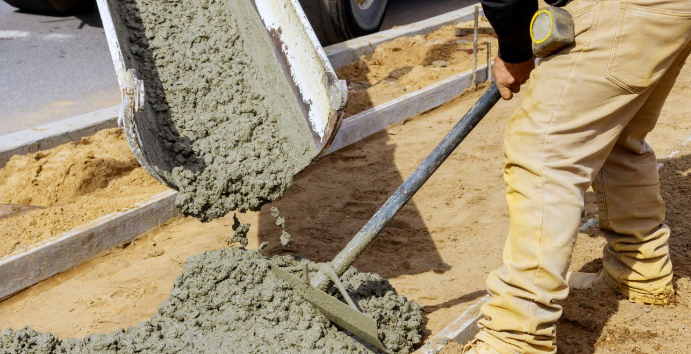
Concrete performance starts with getting the proportions right. Cement, sand, coarse aggregate, and water each affect how fresh concrete behaves and how well it performs after curing. For many general-purpose applications, the traditional 1:2:4 concrete mix ratio is the standard. It uses one part cement, two parts sand, and four parts coarse aggregate by volume. Water is added separately and controlled according to the required workability, aggregate moisture, and intended use.
This ratio can work for certain smaller, non-structural applications, but it does not suit every concrete job. Structural work requires a specified mix based on strength, loading, exposure, and other project requirements.
What Does the 1:2:4 Concrete Mix Ratio Mean?
The 1:2:4 ratio describes the relative quantities of the three dry ingredients. The actual batch size can increase or decrease while maintaining the same proportions.
For example:
| Material | Proportion | Function |
| Cement | 1 part | Binds the materials together |
| Sand | 2 parts | Fills smaller spaces |
| Coarse aggregate | 4 parts | Provides bulk and stability |
| Water | Added separately | Activates cement and provides workability |
A single bucket can serve as the measuring unit for a small batch. One bucket of cement would then be combined with two buckets of sand and four buckets of coarse aggregate.
Keeping the same measuring method throughout the batch helps prevent variations in material proportions. Filling each measure consistently matters as well, since compacted and loosely filled materials contain different quantities.
See also: Is Saskatchewan a Good Province to Immigrate to in 2026?
What Goes Into General-Purpose Concrete?
Concrete relies on several materials working together. Changing the quantity or condition of one ingredient can affect workability, strength, durability, and finished appearance.
Cement Creates the Binding Paste
Cement reacts with water through hydration, forming the paste that binds sand and coarse aggregate as the concrete hardens. Its content needs to remain balanced with water and aggregate quantities, since adding more cement alone does not guarantee higher strength or better performance.
Sand Fills Fine Spaces
Fine aggregate occupies spaces between larger particles and contributes to workability. Clean, well-graded sand helps create a more consistent and compact mixture.
Sand quality matters because contaminated or poorly graded material can affect the behaviour of fresh concrete and the performance of the finished surface.
Coarse Aggregate Provides Structure
Crushed stone or gravel makes up much of the concrete’s volume. Aggregate size, grading, shape, and quality all influence how easily concrete can be mixed, placed, and compacted.
Aggregate selection should account for:
- Required concrete strength
- Reinforcement spacing
- Placement method
- Concrete thickness
- Desired surface finish
Water Activates the Cement
Water begins the hydration process and gives fresh concrete the workability needed for mixing, placement, and compaction. Excess water can create additional pore space as concrete cures, potentially reducing strength and durability.
How Much Water Does a 1:2:4 Mix Need?
Water does not have a fixed position within the 1:2:4 proportion. Its quantity depends on cement content, aggregate moisture, required workability, temperature, and other mix conditions.
The water-to-cement ratio has a particularly strong influence on concrete strength. Adequate water is needed for hydration and workable placement, but excess water can reduce the quality of hardened concrete.
Excess water may contribute to:
- Lower compressive strength
- Greater porosity
- Increased drying shrinkage
- Reduced durability
- Surface defects
Wet sand also needs attention because moisture already present in the aggregate contributes to the total water content.
Where Can a 1:2:4 Mix Be Used?
Traditional 1:2:4 concrete can suit general-purpose applications where a specific structural concrete class has not been prescribed. It is most appropriate for work where loads and performance requirements are relatively straightforward.
Common examples include:
- Garden paths
- Small domestic slabs
- Minor concrete repairs
- Non-structural posts
- General outdoor concrete work
- Certain low-load applications
The application still needs to be assessed before selecting the mix. Thickness, ground conditions, reinforcement, loading, drainage, exposure, and expected service life can all influence the appropriate concrete specification.
When Should A Basic Nominal Mix Be Avoided?
A simple nominal ratio should not automatically be used for structural concrete. Projects involving significant loads or specified performance need tighter control over the concrete’s composition and properties.
| Application | Reason for greater mix control |
| Structural foundations | Concrete may form part of the building’s load-bearing system |
| Reinforced slabs | Strength and durability may be specified |
| Beams | Concrete carries significant structural loads |
| Columns | High compressive demands require predictable performance |
| Commercial structures | Project specifications normally define concrete requirements |
| Heavily loaded areas | Concrete must withstand known service conditions |
Where a project specifies a concrete strength class, that requirement should determine the mix rather than a traditional 1:2:4 proportion.
Is 1:2:4 the Same as C20, C25, or C30?
A mix ratio and a concrete strength class describe different properties. The 1:2:4 ratio defines the relative quantities of cement, sand, and coarse aggregate by volume. Classifications such as C25/30 specify compressive strength based on standardised testing.
Final strength depends on several factors:
- Cement type and content
- Water-to-cement ratio
- Aggregate quality
- Aggregate grading
- Mixing accuracy
- Compaction
- Curing
- Testing conditions
Two batches using the same nominal ratio can therefore produce different strength results. Structural concrete should be produced to the required strength class rather than assuming that 1:2:4 corresponds to a particular grade.
How Should Concrete Materials Be Measured?
Consistent measurement is essential when preparing a nominal mix on site. Small variations between batches can change the balance of cement, sand, aggregate, and water.
- Use One Measuring Unit: A bucket or box can be used as the volume measure for smaller batches. Keep the same container throughout the mixing process.
- Keep Fill Levels Consistent: Avoid tightly packing one material while loosely filling another. Consistent filling produces more reliable proportions.
- Account for Aggregate Moisture: Sand and other aggregates may contain moisture before mixing. That water becomes part of the concrete and can affect the intended water-to-cement ratio.
- Avoid Estimating Quantities: Shovel counts and visual estimates can produce inconsistent batches. Measured quantities provide better control over material proportions.
What Happens When the Mix Is Incorrect?
Poor proportions can affect concrete at several stages, beginning with workability and continuing through curing.
| Problem | Possible effect |
| Excess water | Higher porosity and lower strength |
| Insufficient cement | Weaker binding between aggregate particles |
| Uneven proportions | Inconsistent performance between batches |
| Poor mixing | Uneven cement paste distribution |
| Inadequate compaction | Trapped air and internal voids |
| Poor curing | Reduced strength development |
Correct proportions therefore need to be supported by proper mixing, placement, compaction, and curing.
How Should General-Purpose Concrete Be Mixed?
A controlled mixing process helps maintain consistent concrete from one batch to the next.
- Measure the materials: Prepare cement, sand, and coarse aggregate using consistent quantities.
- Combine the dry ingredients: Mix the cement, sand, and aggregate until the dry materials are evenly distributed.
- Add water gradually: Introduce water while mixing rather than adding an uncontrolled quantity at once.
- Check workability: Concrete should be workable enough for proper placement and compaction without becoming excessively wet.
- Place promptly: Move the fresh concrete into position while it remains workable.
- Compact the concrete: Remove trapped air and ensure the mix fills the available space properly.
- Cure the concrete: Protect the newly placed material from rapid moisture loss and unsuitable conditions during early strength development.
When Is Ready-Mix Concrete A Better Choice?
Site mixing can be practical for smaller general-purpose applications, but larger projects can become difficult to control when every batch needs separate measuring and mixing.
Ready-mix concrete provides controlled batching and can be supplied to a specified strength class. It can also reduce the amount of material handling required on site.
Ready-mix can be particularly useful for:
- Structural foundations
- Reinforced slabs
- Large footings
- Commercial construction
- High-volume pours
- Projects requiring specified concrete grades
- Applications where consistent batch quality is essential
The choice ultimately depends on the required volume, strength, access, equipment, and project specification.
Final Thoughts
The 1:2:4 concrete mix ratio remains a useful traditional proportion for certain general-purpose applications, particularly where a specific structural concrete class has not been required. It is not a universal mix for every project, so the intended use and required performance should always guide the choice.
For structural work, the required strength, loading, exposure, reinforcement, and project specification should determine the concrete mix. Accurate measurement, controlled water, proper mixing, thorough compaction, and suitable curing then help the concrete achieve the expected performance.
For UK projects that require ready-mix concrete, Pro-Mix Concrete supplies concrete for domestic, commercial, and construction applications, with delivery and pumping options to suit different site requirements. Choosing the right concrete specification and arranging delivery around the site’s access and pour requirements can help keep the work on schedule.
Read More: How High and Far Can A Concrete Boom Pump Actually Reach